

13 Nov It’s Different Here: How Northeast Charter Helps Maine Camps Start the Magic
If you’ve ever stood on a dirt road outside a Maine camp at sunrise, you know: the magic doesn’t start at the waterfront.
It starts in the parking lot.
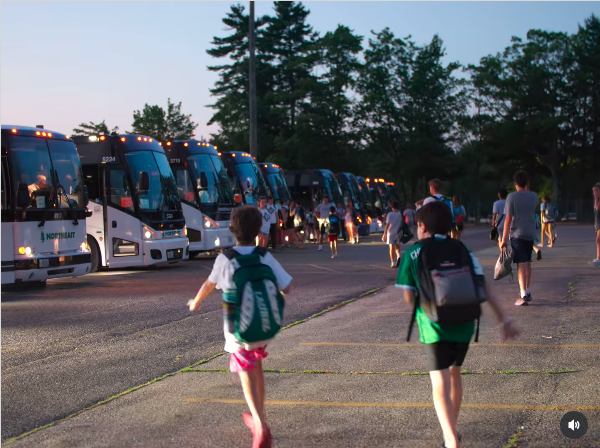
Engines idling. Counselors in camp T-shirts bouncing on their toes. Parents doing one last “Did you pack your…?” shuffle. And a coach from Northeast Charter easing in, air brakes sighing, full of kids who are about to have a week—or a month—that they’ll talk about for the rest of their lives.
At Northeast Charter, we talk a lot about how “it’s different here.”
Maine camps are a big part of that story.
Maine Camps: A Small State With a Huge Summer
Maine isn’t just a camp state—it’s the camp state.
Each summer, more than 60,000–65,000 children experience Maine camps, many of them staying overnight for weeks at a time. (Maine Camp Experience) There are more than 145 member youth camps and outdoor programs in the Maine Summer Camps organization alone, with broader estimates putting the total number of camps in the state well over 150. (Maine Summer Camps) Many of these camps have been running for a century or more.
This isn’t a side note in Maine’s story—it’s part of the identity of the state. Camp is officially described as a “heritage industry,” right alongside lobstering and logging. (Maine State Legislature)
And the impact is enormous:
- Maine summer camps serve upwards of 65,000 kids and employ around 13,000 seasonal staff each year. (Maine State Legislature)
- Their economic influence lands just under $500 million annually, once you factor in operations, jobs, and the visitors camps draw into the state. (Centralmaine.com)
- About 145 camps on lakes alone serve around 60,000 campers each summer, generating at least $170 million in direct spending and another $156 million in indirect spending in those lake communities. (Lakes)
But behind all those numbers is something quieter and more powerful:
kids discovering who they are, in a place that feels like a second home.
A Community Wrapped Around Every Camper
Maine camps don’t just “run programs.” They create little temporary villages.
Local students and teachers pick up summer jobs. College kids come back year after year to work as counselors. Small businesses supply everything from food and fuel to arts & crafts and paddles. (Maine Summer Camps) Airports, hotels, diners, ice cream stands, and general stores in camp regions all feel the lift when camp is in session. (Centralmaine.com)
And crucially, camps work hard to make that experience accessible, not just exclusive. Many Maine camps offer financial aid and campership programs so that kids from lower-income families can attend, not just those with deep pockets. (Maine Summer Camps)
Camps become places where a kid from New York, a kid from Boston, and a kid from Bangor all share a bunk, trade stories, and walk away feeling like Maine is “their” place too. Those emotional connections matter. They’re strong enough that many campers eventually return as counselors, staff, and even as adults who choose to live and work in Maine. (Maine Summer Camps)
All of that starts with something very simple:
getting them safely, calmly, and comfortably to camp.
That’s where Northeast Charter comes in.
Why the Journey Matters (Especially With Kids)
If you’re a camp director, activity coordinator, or school partner, you already know:
the first bus ride sets the tone.
A chaotic, uncomfortable, “white-knuckle” trip to camp doesn’t just stress kids and parents. It puts pressure on your staff before the week even begins.
We’ve spent decades moving students, campers, and youth groups all over Maine and beyond. The difference at Northeast Charter is that we don’t see these as “just another run.” We know that, for many of these kids, this is the big moment—their first time away from home, their first Maine summer, their first glimpse of the lake through the coach window.
So we show up differently.
- Experienced drivers who’ve run these camp roads for years.
- Teams who understand how load-in works when you’ve got trunks, duffel bags, instrument cases, and a line of minivans behind you.
- Calm, professional onboard presence that reassures parents and helps anxious campers settle in.
On the road, our drivers become a quiet extension of your camp culture: friendly but firm, upbeat but focused, always thinking three steps ahead on safety and timing.
“Right-Sized” Equipment for Real Camp Life
Not every trip to camp looks the same.
Sometimes you’ve got a full session arriving from an out-of-state airport with luggage for weeks. Sometimes it’s a local day-camp program shuttling in from a nearby school. Sometimes it’s a leadership retreat with a smaller group of staff.
That’s why our “right-sized equipment” matters so much.
Instead of forcing every group into the same type of vehicle, we match the equipment to the journey:
- Full-size motorcoaches for large sessions, airport transfers, and long-haul travel.
- Mid-size and smaller coaches when your group size or route doesn’t justify a 56-passenger bus.
- Thoughtful use of luggage bays, climate control, and seating layouts to make the ride comfortable—and efficient—for your specific trip.
This isn’t just about comfort. It’s about stewardship.
Right-sized equipment helps camps:
- Avoid paying to move lots of empty seats.
- Use fewer vehicles when a single properly chosen coach can handle the load.
- Reduce wear, fuel use, and congestion on those small camp roads.
In other words, we bring the same respect to your transportation plan that you bring to your program plan.
Culture on the Coach, Not Just at the Campfire
At Northeast Charter, we’re very aware that our drivers are often the first camp adults your families meet who don’t share your logo.
So we take that seriously.
We train our drivers to:
- Communicate clearly with parents and staff during arrival and departure.
- Support your expectations—seat belts, behavior, quiet time, you name it.
- Model the kind of calm, respectful presence that helps campers feel safe.
When you talk about your camp’s community, culture, and environment, we want your transportation to feel like a natural extension of that, not an interruption.
For Maine families, that matters.
For out-of-state families sending their kids hours away by coach, it matters even more.
Why It’s Different Here
Maine camps are special. The numbers prove it, and the stories do too.
Tens of thousands of kids.
Hundreds of camps.
An economic engine for rural communities.
A heritage industry that shapes lives and futures every single summer. (Maine Camp Experience)
At Northeast Charter, we’re proud to be part of that ecosystem—not as an afterthought, but as a trusted link in the chain that takes a camper from “nervous in the parking lot” to “grinning on the dock.”
Because here, it really is different.
Different in how we train our drivers.
Different in how we choose and maintain our fleet.
Different in how seriously we take the responsibility of moving kids to and from places that change them.
If you’re planning transportation for a Maine camp, school, or youth group, we’d love to help you build a journey that reflects the magic waiting at the end of the road.
After all, the memories start long before the first campfire.
They start the moment the coach from Northeast Charter pulls into view.
No Comments